
How Does Cognitive Behavioural Hypnotherapy (CBH) Work?
Perhaps you dread driving, avoid speaking in public, feel anxious in social situations, or struggle with habits you desperately want to change. You tell yourself, “I know I’ll be okay,” but your mind and body don’t seem to get the message.
7/22/20263 min read
Have you ever wondered why you know something isn’t dangerous, yet your body reacts as if it is?
Perhaps you dread driving, avoid speaking in public, feel anxious in social situations, or struggle with habits you desperately want to change. You tell yourself, “I know I’ll be okay,” but your mind and body don’t seem to get the message.
This is where Cognitive Behavioural Hypnotherapy (CBH) can help.
CBH combines two well-established approaches: Cognitive Behavioural Therapy (CBT) and clinical hypnosis. Together, they help you understand why you think, feel and behave the way you do, and more importantly, how to change it.
It All Starts with a Thought
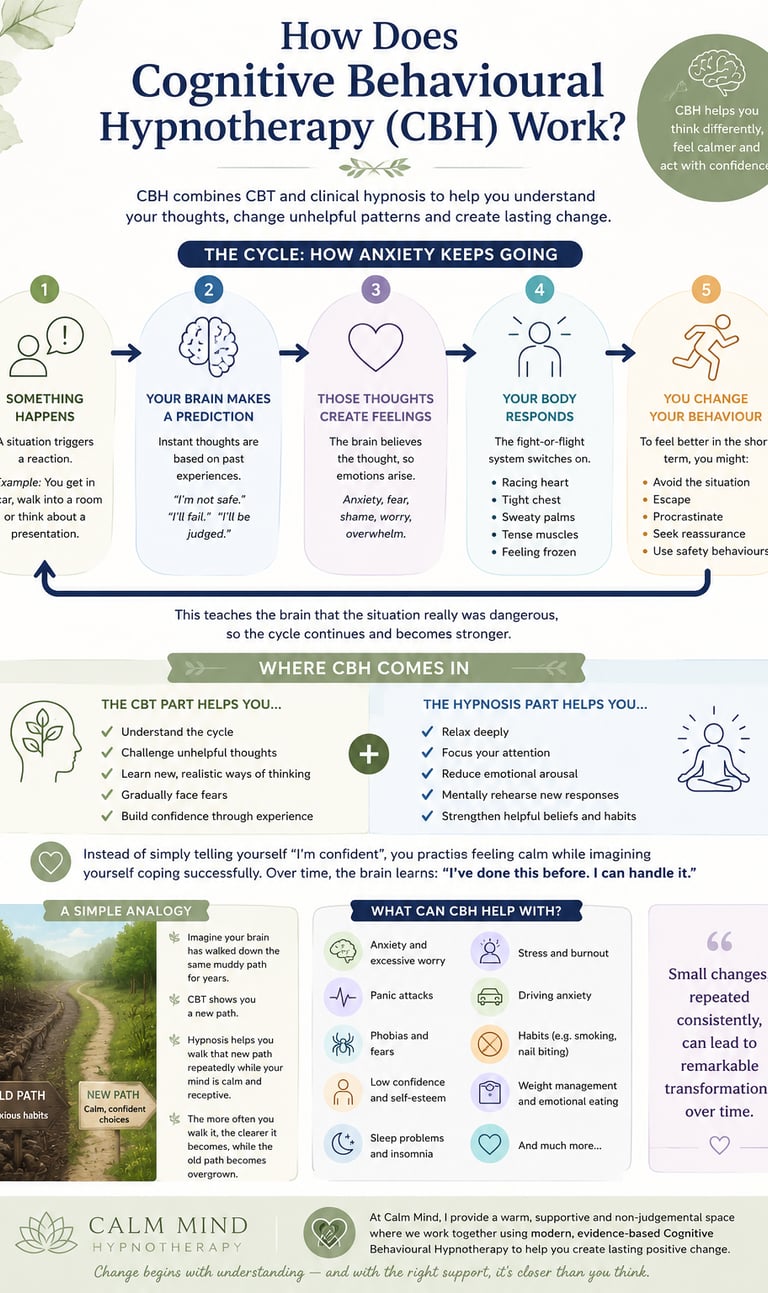
Imagine you’re about to give a presentation at work.
A thought flashes through your mind:
“I’m going to make a fool of myself.”
Your brain treats that thought as if it’s true.
Almost instantly, your body responds.
Your heart races. Your breathing becomes shallow. Your muscles tense. You feel sick with anxiety.
To escape those uncomfortable feelings, you might avoid the presentation altogether or rush through it while feeling overwhelmed.
Although avoiding the situation brings temporary relief, it also teaches your brain that the situation must really be dangerous. The cycle continues, and each time it becomes a little stronger.
Breaking the Cycle
CBH helps interrupt this pattern.
The Cognitive Behavioural Therapy element helps you recognise unhelpful thinking patterns, understand how they influence your emotions and behaviour, and develop healthier, more balanced ways of responding.
Instead of automatically believing every anxious thought, you learn to question it.
You begin replacing fear-driven predictions with realistic, evidence-based thinking.
At the same time, you gradually build confidence by facing situations in manageable steps, allowing your brain to discover that you are capable of coping.
Where Hypnosis Fits In
Clinical hypnosis isn’t about losing control or being “put under.”
It’s simply a state of focused attention and deep relaxation, rather like becoming completely absorbed in a good book or a film.
In this relaxed state, it often becomes easier to practise new ways of thinking, responding and imagining success.
Rather than repeatedly rehearsing fear, you begin mentally rehearsing calmness, confidence and resilience.
The brain learns through repetition.
The more often you experience yourself coping successfully—both in therapy and in real life—the more natural those responses become.
Creating New Pathways
A helpful way to think about CBH is to imagine your brain as a network of woodland paths.
Every time you think or react in the same way, you walk down the same path.
After years of anxiety, avoidance or self-doubt, that path becomes well worn and automatic.
CBH helps you create a new path.
Each time you practise healthier thinking, calmer breathing, helpful behaviours and positive experiences, the new pathway becomes stronger.
Eventually, your brain begins choosing the healthier path automatically.
What Can CBH Help With?
Cognitive Behavioural Hypnotherapy has been used to help people with many common difficulties, including:
* Anxiety and excessive worry
* Stress and burnout
* Panic attacks
* Low confidence and self-esteem
* Phobias
* Driving anxiety
* Public speaking and performance anxiety
* Sleep problems and insomnia
* Habits such as nail biting or smoking
* Weight management and emotional eating
* Chronic pain management
* Health anxiety
* Procrastination
* Building resilience, emotional wellbeing, Sports performance, pain management and gut issues.
Every person is different, so therapy is always tailored to your individual needs and goals.
A Practical, Evidence-Based Approach
One of the greatest strengths of CBH is that it doesn’t simply focus on helping you feel better in the moment.
It aims to teach you skills that you can continue using long after therapy has finished.
The goal isn’t to remove every difficult thought or emotion—that’s part of being human.
Instead, it’s about changing the way you respond to them, so they no longer control your life.
Imagine Feeling Different…
Imagine approaching situations with greater calm instead of fear.
Imagine sleeping more peacefully.
Imagine feeling more confident, more resilient and more in control of your thoughts.
Small changes, repeated consistently, can lead to remarkable transformations over time.
At Calm Mind, I provide a warm, supportive and non-judgemental space where we work together using modern, evidence-based Cognitive Behavioural Hypnotherapy to help you create lasting positive change.
Change begins with understanding—and with the right support, it’s often much closer than you think.

